Why Your Professional Services Pipeline Keeps Drying Up — And the Structural Fix That Actually Works
Your pipeline dries up because delivery and BD compete for the same people — and delivery wins every time. Here's the structural fix that breaks the feast-famine cycle for good.

If your professional services pipeline keeps drying up despite consistent client demand, the cause is structural: your rainmakers and your delivery team are the same people, and delivery wins every priority competition. The fix isn't better time management or more discipline about protecting BD calendar slots. It's building a BD system that runs independently of whether you have free time this week.
Professional services firms — consulting, legal, accounting, marketing, HR — share a nearly universal sales problem. The one you talk about is "business development takes too much time." The real problem is deeper.
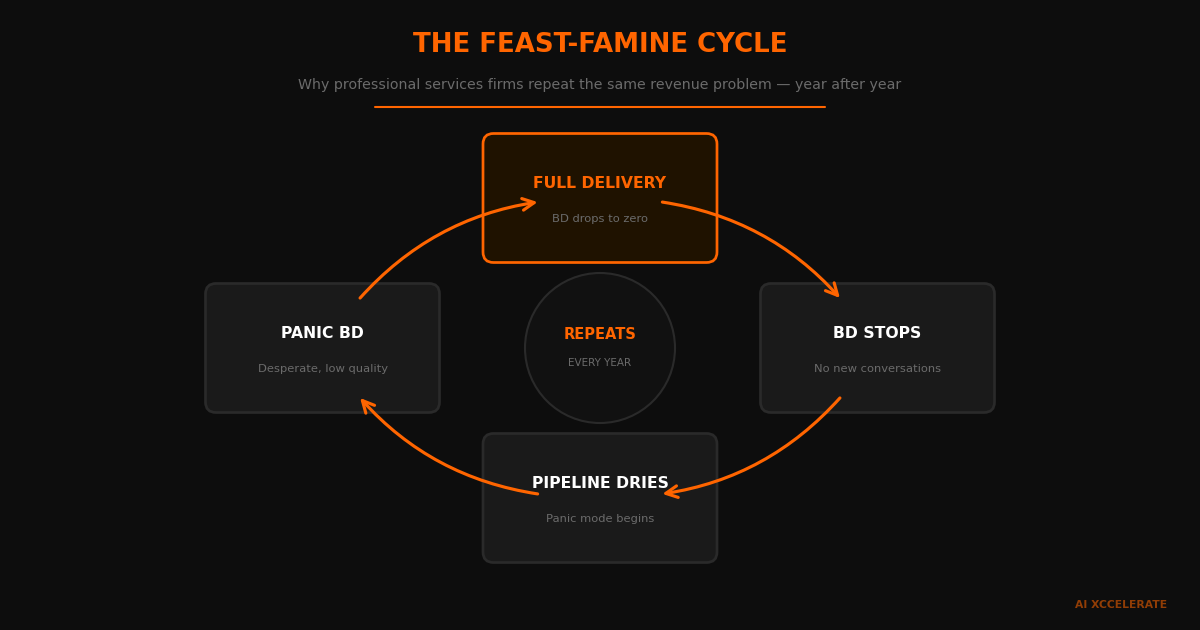
The real problem is that revenue and delivery are competing for the same people. The partners who bring in business are the same people delivering the work. When delivery is busy, business development stops. When BD stops, the pipeline dries up. And then the feast-famine cycle starts again — the same cycle your firm has been managing for years.
Most firms treat this as a scheduling problem: "we need to protect BD time." The schedule gets protected for three weeks until a client emergency hits, and then the BD calendar empties out again. It's not a scheduling problem. It's a structural problem. The fix requires separating the execution of BD from the senior partner's bandwidth — not asking partners to protect calendar slots more diligently.
TL;DR
- Professional services revenue is almost universally subject to the feast-famine cycle: full delivery means no BD; quiet pipeline means BD panic
- The root cause: the same people responsible for BD are also responsible for delivery — and delivery always wins every priority competition
- Most professional services BD pipeline dies in the "keeping warm" stage: the prospect who isn't ready yet but never gets a follow-up
- Automating the nurture layer (4–12 month drip for "not yet" prospects) is the single highest-leverage fix for professional services firms
- Firms that separate BD outreach execution from delivery work grow faster — based on our work with AI Xccelerate clients, the difference is often 30–50% more revenue per year
- The feast-famine cycle is structural, not motivational — it won't be fixed by trying harder
Why Does Delivery Always Beat Business Development at Professional Services Firms?
Business development requires your personal time and credibility as a senior partner or founder. A client deliverable due Friday beats a business development lunch scheduled for Friday. Every time. Without exception. This isn't a failing of discipline — it's the rational response to competing urgent demands.
The result: your BD activity is inversely correlated with your delivery load. When your firm is busiest and most successful, BD is at its minimum. When delivery quiets down, BD ramps up in a panic. The pipeline that arrives from that panic-BD period is lower quality, lower priority, and harder to close because you're desperate rather than selective.
This is the feast-famine cycle, and it's structural. It won't be solved by trying harder to protect BD time. It will only be solved by building a BD system that runs independently of whether the partners have free time this week.
What Are the Hidden Costs of the Feast-Famine Cycle?
Cost 1: Revenue volatility. Every cycle of pipeline panic followed by delivery overwhelm produces a revenue curve that looks like a sawtooth rather than a growth line. Planning is difficult, hiring is difficult, and your business feels fragile despite consistent demand.
Cost 2: Relationship loss. The "not yet" prospect who expressed genuine interest 6 months ago but needed to wait until Q3 doesn't get the follow-up call they were expecting. They hire a competitor who stayed in touch. The relationship that took 12 months to build is lost to a firm that had a better follow-up system — not a better service.
Cost 3: Competitive disadvantage at scale. Firms with systematic BD processes build warm pipelines continuously — even during busy periods. When a new project opportunity opens up, they're talking to 40 warm prospects. Your firm is talking to whoever is in the partner's most recent email thread.
Is Your BD Structurally Dependent on Partner Time? (The AIX BD Independence Score)
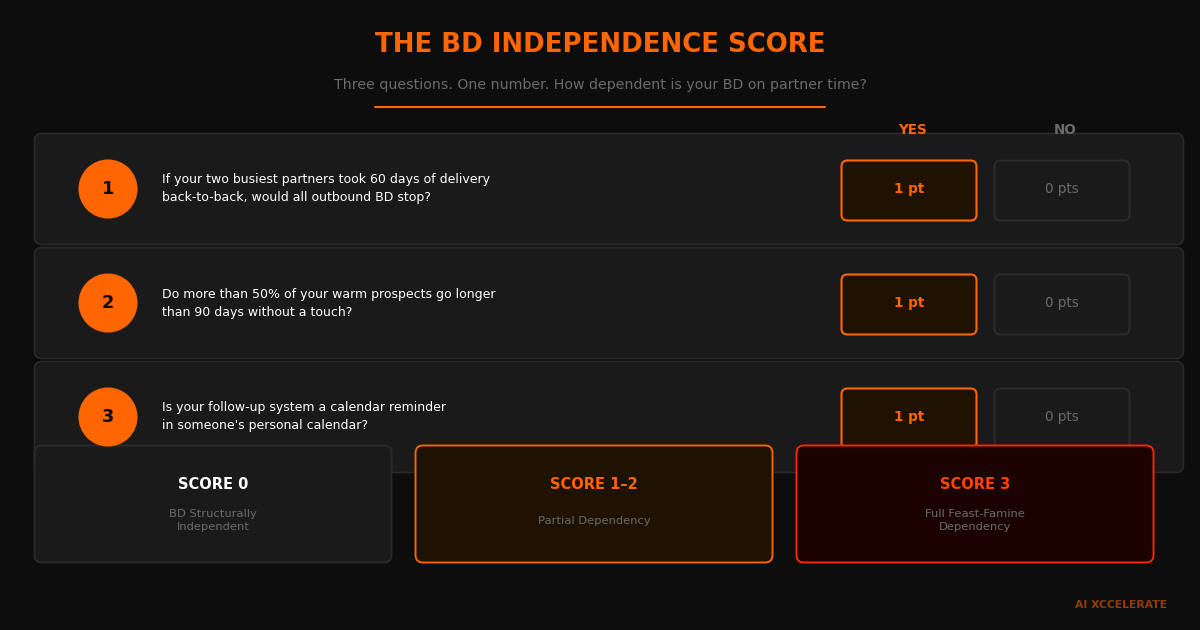
Before you fix the system, it helps to know how dependent your current BD is on senior bandwidth. Answer these three questions honestly:
| Question | Yes | No |
|---|---|---|
| If your two busiest partners took 60 days of client delivery back-to-back, would all outbound BD stop? | 1 point | 0 points |
| Do more than 50% of your "warm" prospects go longer than 90 days without a touch? | 1 point | 0 points |
| Is your follow-up system a calendar reminder in someone's personal calendar? | 1 point | 0 points |
Score 0: Your BD is structurally independent. You likely already have a systematic nurture process.
Score 1–2: You have partial dependency. BD slows during busy periods but doesn't stop entirely. The nurture gap is costing you relationships you don't know you're losing.
Score 3: Full feast-famine dependency. Your pipeline is directly correlated with partner availability. Every busy delivery period is silently destroying next quarter's revenue.
Most professional services firms score 2 or 3. If you scored 3, the rest of this post is written for you.
What Happens to the "Not Yet" Prospects in Your Pipeline?
A CFO who says "not now, call me in Q3" is one of the most valuable prospects your firm has — if you actually call them in Q3.
Most firms don't. The original call gets logged somewhere (maybe). The follow-up date goes in the partner's calendar. By Q3, the partner is deep in a client engagement. The calendar reminder gets snoozed twice, then ignored. The prospect never gets the call.
Twelve months later, that prospect is mentioned in a team meeting as someone who "seemed interested last year." No one remembers what was discussed. The relationship has to restart from scratch.
This is the nurture problem. It's not a technology problem or a CRM problem — it's a process problem. The warm prospect who was 4–6 months away from being ready needed 6 months of consistent, low-effort touches to stay warm until the timing was right. Those touches never happened because your partner was on a client site.
How Do You Fix the Nurture Problem Without Adding to Your Workload?
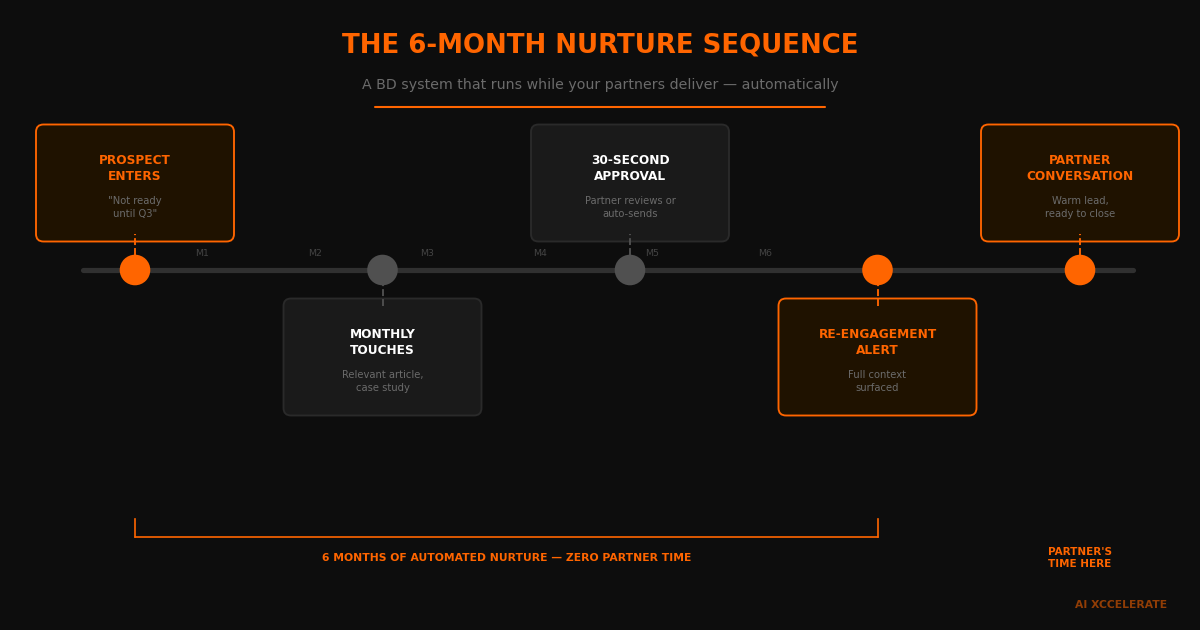
The solution isn't to ask partners to spend more time nurturing prospects. They won't, because they'll be delivering client work. The solution is a system that nurtures automatically, surfaces re-engagement opportunities with full context, and reserves the partner's time for the conversation that requires them — not the 6 automated touches that precede it.
Here's what the system looks like in practice:
Any qualified prospect who isn't ready to engage enters a structured 6-month nurture sequence. One personalized touch per month: a relevant article, a case study specific to their industry, a market insight, a brief check-in. Each touch takes 30 seconds for you to review and approve, or sends automatically. At the scheduled re-engagement date, the system surfaces an alert to you with full conversation history and a suggested re-engagement message.
Your involvement: approving touches that require personalization, and handling the conversations that result. Not maintaining the system manually.
Why Does Personalized Nurture Matter More in Professional Services?
Generic nurture ("just checking in") doesn't maintain warmth. In professional services, where the sale is built on trust and expertise, your nurture content needs to demonstrate ongoing expertise relevance.
A regulatory update specific to their industry. A case study from a company that had the exact problem they mentioned. A brief note about a market development that affects their specific situation. These touches maintain the "we understand your world" positioning that makes the eventual re-engagement feel like a continuation of a valuable relationship rather than a sales call.
This level of relevance requires content — either industry-specific thought leadership or curated external content — and a system that matches the right content to the right prospect based on what you already know about them.
What Does This Look Like in Practice?
A mid-size accounting firm (3 partners, ~$3.2M annual revenue) had a BD problem that looked like a time problem. Each partner carried 30–50 warm relationships at any given time. Historically, they converted about 15% of warm relationships into clients per year — a number the partners suspected was significantly below potential.
They implemented an automated nurture system. All 90+ warm relationships were entered. Each contact received monthly, relevant touches aligned to their industry and the conversation history documented in the CRM.
Year 1 conversion from warm pipeline: 27% — up from 15%. The 12-point improvement came entirely from relationships that previously went cold: prospects who received consistent, relevant touches and re-engaged when the timing was right. The partners' time investment was reviewing the system's output twice a week, approximately 20 minutes total.
Note: This is a composite example based on outcomes AI Xccelerate has observed across professional services clients. Individual results vary.
How Does AI Xccelerate Address the Professional Services BD Problem?
AI Xccelerate's outbound AI agent Jules handles the structured parts of professional services BD that are most consistently neglected: systematic outreach to new-logo prospects and reliable nurture of warm relationships. Jules identifies target companies showing buying signals, builds personalized outreach, and executes the multi-touch follow-up that partners don't have time to do manually.
The result: a BD system that runs continuously regardless of your delivery load. You don't need to protect calendar slots for prospecting — Jules handles that. Your time goes to the conversations that only you can have: the relationship-intensive discovery meetings and client engagements that require your personal expertise and trust.
For a broader look at where AI fits into your team's workflow, read Assist, Augment, or Replace: How SMBs Should Deploy AI Workforce in 2026.
FAQ
Why do professional services firms have inconsistent pipeline? Because the people responsible for generating pipeline are also responsible for delivery — and delivery always takes priority. Without a BD system that runs independently of senior partner bandwidth, your pipeline generation is structurally correlated with how busy the firm is, creating an inverse relationship between workload and growth activity.
What is the "feast-famine cycle" in professional services? It's the repeating pattern of alternating between full delivery capacity — where BD activity drops to near zero and no new conversations are happening — and slow delivery, where panic BD kicks in with sporadic follow-up and lower-quality prospects. The cycle repeats because the root cause is never addressed: BD is dependent on the same partners doing the delivery.
How do I keep warm prospects engaged without spending hours per week? Set up automated nurture sequences: one relevant touch per month (a specific article, a case study from their industry, a market update) that takes 30 seconds to review or sends automatically. The key is relevance — generic "just checking in" messages don't maintain the trust and expertise positioning that professional services sales depends on.
How long is a typical professional services sales cycle? It's highly variable by firm size and service complexity. Based on what we see across our professional services clients at AI Xccelerate, most meaningful first conversations to signed engagements run 3–9 months. The "not yet" prospects who are 3–6 months from readiness are often the most valuable pipeline segment — if they're nurtured rather than lost.
What is the best content to send in a professional services nurture sequence? Specific, relevant insights for the prospect's industry: regulatory updates, market benchmarks, case studies from similar companies. The test is whether the prospect would find it useful even if they never hire you. Generic "we're here when you need us" content doesn't pass that test and signals that you don't actually know their world.
At what firm size should you start systematizing BD? Immediately — even at 3–5 people. The feast-famine cycle is just as damaging at $500K revenue as at $5M, and the infrastructure investment is modest at any size. At $5M you're leaving significantly more money on the table every cycle, which makes the ROI calculation more obvious — but the structural problem is identical at any scale.
Ready to break your firm's feast-famine cycle? Book a 20-minute AI Workforce Audit