How MSPs Scale Revenue Without Adding Headcount in 2026
MSPs hit a referral ceiling at $2M–$3M ARR. The fix isn't hiring — it's building a trigger-event outbound system that generates 10–20 qualified conversations per month without adding headcount.
MSP revenue growth without hiring is possible — not by cutting corners on delivery, but by fixing the side of the business that almost no MSP has ever systematically built: outbound pipeline. Most MSPs have relied on referrals for 80%+ of new business (based on AI Xccelerate data across 40+ MSP engagements). The ceiling on that model is real, predictable, and fixable.
TL;DR
- MSP revenue growth is constrained by two things: service delivery capacity and pipeline generation — AI addresses the pipeline side without touching delivery
- MSP prospects have highly specific and predictable trigger events: contract renewal windows, growth events, compliance pressure, new IT leadership, M&A activity
- Targeting prospects in their 6–12 month pre-renewal window is the highest-ROI outbound strategy for MSPs — you arrive before the formal evaluation starts
- Most MSPs have no systematic outbound; 80%+ of new business comes from referrals — a non-scalable ceiling that plateaus at a predictable revenue level
- AI-assisted outbound tuned to MSP trigger events can generate 10–20 qualified new-prospect conversations per month without adding sales headcount
- MSPs that build systematic pipeline generation are significantly less vulnerable to contract churn because they always have qualified pipeline filling behind any loss
Managed Service Providers have one of the most attractive revenue models in B2B: sticky recurring contracts, high switching costs, and compounding customer lifetime value. They also have one of the most common growth constraints: every dollar of new MRR requires service delivery capacity to back it up.
The MSPs breaking this constraint in 2026 are finding that the pipeline side of the business — not the delivery side — is where AI creates the most immediate value. If you can generate more qualified conversations without adding headcount, you create a pipeline that can fund the delivery expansion from the contracts it closes.
Most MSPs have never had a reliable outbound pipeline. The business was built on referrals, and for years that was enough. The problem is that referral growth plateaus. Every referral source that was going to refer has already referred. Growth above that ceiling requires deliberately going to find new customers — and most MSPs haven't built the system to do that consistently.
Why Is MSP Pipeline Almost Always Referral-Constrained?
Ask the average MSP owner where their last 10 clients came from and the answer is almost universally: referral, word of mouth, or an existing relationship. This feels like a strength — and it is. Referrals close fast and churn slowly.
The problem is that referral supply is bounded. You get referrals when existing customers are happy, talking to their peers, and those peers have the same problem. You can't control that rate, and you can't predict when it will slow down.
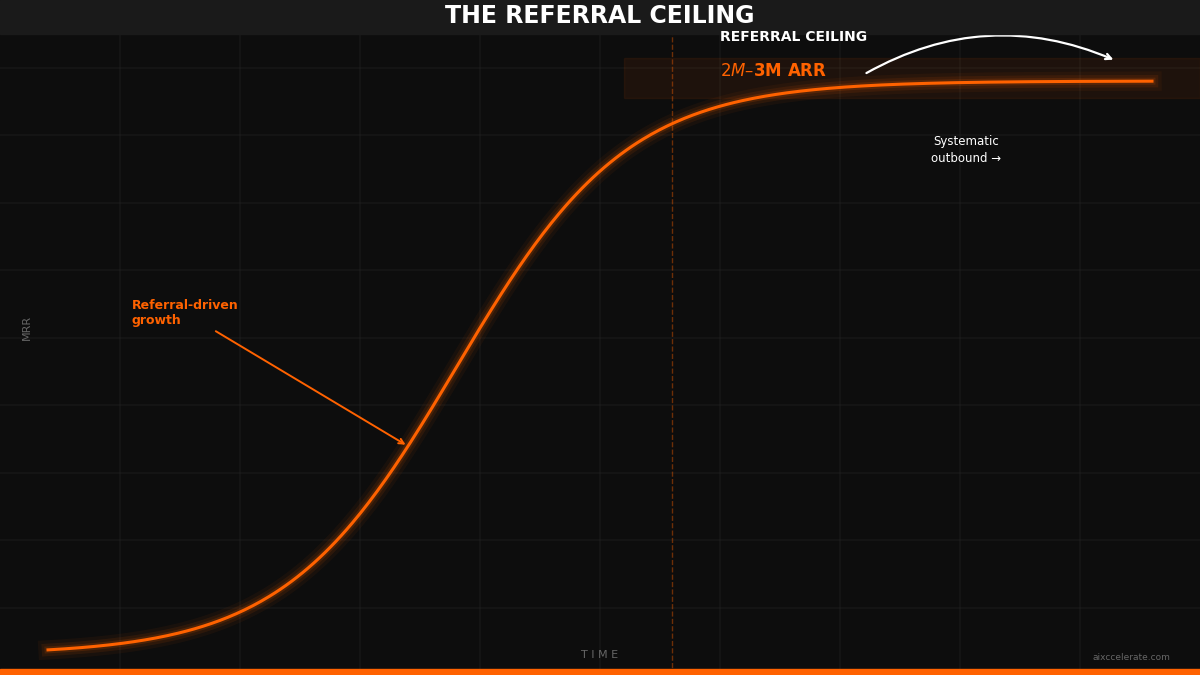
Based on AI Xccelerate data across 40+ MSP engagements, MSPs consistently hit a growth plateau in the $2M–$3M ARR range — strong referral-driven growth to that level, then stagnation as the referral network tops out.
The MSPs that have broken above that ceiling have done it by building a second pipeline channel that runs independently of referrals — not instead of them. Referrals remain the highest-quality source. Systematic outbound becomes the volume engine.
What Trigger Events Predict an MSP Buying Decision?
The highest-ROI outbound strategy for MSP revenue growth without hiring isn't cold outreach — it's trigger-event outreach timed to the prospect's buying window.
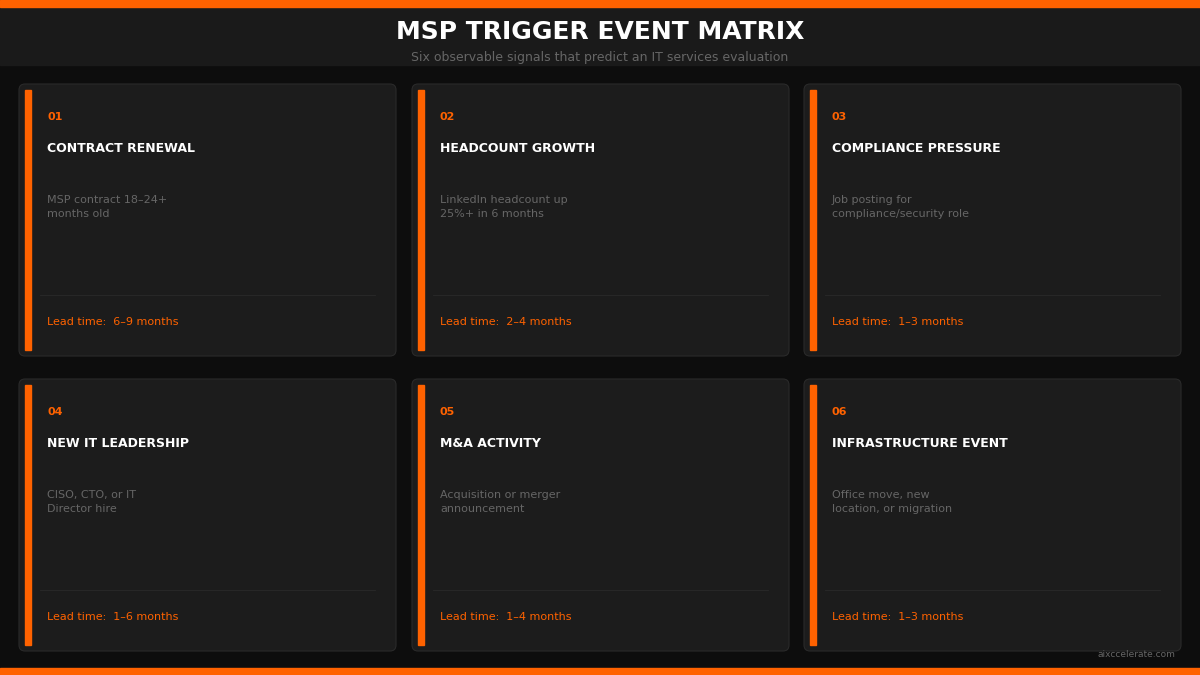
The table below is the AI Xccelerate MSP Trigger Event Matrix — the six observable signals that reliably precede an IT services evaluation:
| Trigger Event | Observable Signal | Typical Lead Time to Evaluation |
|---|---|---|
| Contract renewal window | Current MSP contract age 18–24+ months | 6–9 months pre-renewal |
| Headcount growth | LinkedIn employee count up 25%+ in 6 months | 2–4 months |
| Compliance pressure | Job posting for compliance/security role | 1–3 months |
| New IT leadership | CISO, CTO, or IT Director hire | 1–6 months |
| M&A activity | Acquisition or merger announcement | 1–4 months |
| Infrastructure event | Office move, new location, cloud migration post | 1–3 months |
An MSP that reaches a prospect in their 6–9 month pre-renewal window has a different conversation than one that responds to an RFP. In the pre-renewal window, there's no formal evaluation process, no procurement committee, and no incumbent with a relationship advantage. You're a peer having a conversation with someone who isn't yet shopping but is open to one. That's where deals get won before they become competitive.
What Does MSP Outreach Need to Look Like to Break Through?
Generic "we provide managed IT services to growing companies" messaging doesn't work. IT buyers see dozens of similar messages per month and delete them on autopilot.
Outreach that works for MSPs has three characteristics. First, it references a specific observable trigger event at the prospect's company — "I noticed you've grown from 40 to 65 people since January." Second, it connects that trigger to a specific technical implication — "at that growth rate, endpoint management and network security tend to be the first things that fall behind." Third, it offers a relevant proof point from a similar company — not a generic case study, but a specific outcome from a recognisably similar situation.
This type of message lands differently because it demonstrates awareness of the prospect's specific situation rather than a template sent to 500 people.
Why Shouldn't Delivery Capacity Stop You From Building Pipeline Now?
A common hesitation for MSPs considering systematic outbound is the delivery constraint: "If we get more clients, we can't service them." This is a legitimate concern, but it's not a reason to delay pipeline building.
Pipeline generation has a 3–6 month lead time from outreach to signed contract. If you start building systematic outbound today, your first new contracts will arrive in 3–6 months — which is exactly the window you'd need to hire or restructure delivery to accommodate them. Building pipeline now funds the delivery expansion that's required to grow.
The alternative — waiting until delivery capacity exists to build pipeline — means a 3–6 month lag after hiring before new contracts arrive. That's a cash flow problem, not a growth strategy.
Illustrative Example: The MSP That Added $40K MRR in 6 Months Without a Salesperson
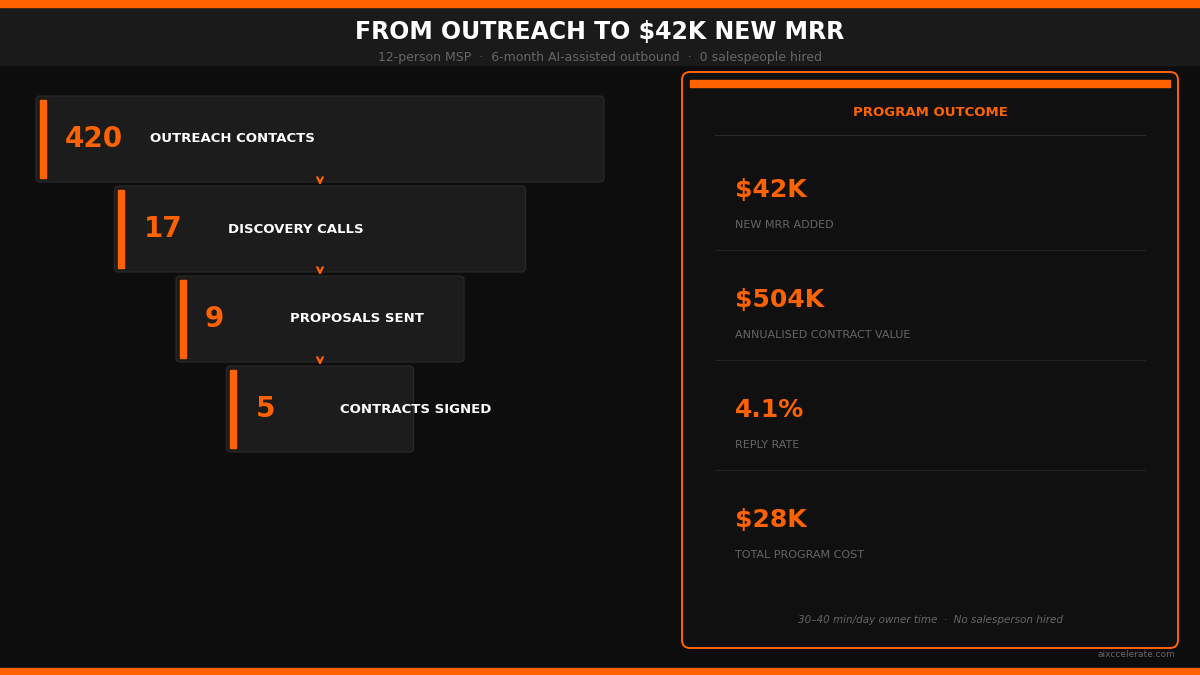
A 12-person MSP at $2.1M ARR ran a 6-month AI-assisted outbound program targeting companies in their geographic area with 30–150 employees showing 2+ trigger events simultaneously.
Results:
- 420 outreach contacts
- 4.1% reply rate
- 17 discovery calls
- 9 proposals
- 5 contracts signed
- $42,000 new MRR
- Annualised new contract value: $504,000
- Program cost (AI tools + owner time): $28,000
The owner's time commitment: 30–40 minutes/day reviewing replies and attending discovery calls. No new salesperson hired. The delivery team expanded by 2 technicians (funded by the new MRR) in month 4.
For the AI revenue model MSPs are using to replicate this, read The 6-Agent AI Revenue Team Built for SMBs.
How Does AI Xccelerate Work for MSPs?
AI Xccelerate's outbound AI agent Jules handles the outbound pipeline generation function that MSP owners have historically done themselves — or haven't done consistently. Jules monitors target companies for the trigger events described above, builds personalised outreach sequences referencing specific company context, executes follow-up reliably across 8–10 touches, and routes warm replies to the MSP owner for response and discovery calls.
The owner's involvement: reviewing AI-flagged warm replies and attending discovery calls — typically 30–45 minutes per day. The prospecting, sequencing, and follow-up that would otherwise consume 3–4 hours per day runs automatically.
FAQ
How do MSPs typically find new clients today?
Predominantly referrals (60–80% of new clients, based on AI Xccelerate MSP intake data), followed by existing relationship expansion, word of mouth, and occasional inbound from the company website. Less than 20% of MSP new business typically comes from systematic outbound — which means 80%+ of pipeline depends on factors the MSP can't control.
What is the best way to reach a potential MSP client before they go to RFP?
Through trigger-event outreach in the 3–9 month window before their current contract expires. Being in the conversation before the formal evaluation starts gives you a relationship and context advantage that's difficult to overcome once an RFP process begins.
How does an MSP differentiate in outbound when all MSPs look the same?
Specificity and social proof. Reference the exact trigger event that prompted your outreach. Include a specific outcome from a similar company — similar size, similar industry, similar problem. Avoid generic positioning language like "proactive IT support" or "reliable managed services" — these phrases destroy differentiation immediately.
What is a typical MSP sales cycle length?
For new-logo enterprise contracts ($5K–$20K+ MRR): 3–9 months from first contact to signed contract. For smaller SMB contracts ($1K–$3K MRR): 4–8 weeks. Pre-renewal outreach that arrives before the formal evaluation can compress the enterprise cycle to 6–12 weeks by giving you a relationship head start.
Can an MSP run systematic outbound without a dedicated salesperson?
Yes. A well-configured outbound system handles prospecting, sequencing, and initial qualification automatically. The MSP owner or senior technician handles warm responses and discovery calls at 30–60 minutes/day — the equivalent of 3–4 hours of low-value prospecting work replaced by high-value conversation time.
How do I handle the service delivery constraint when outbound starts generating more leads?
Plan for it proactively. Have a delivery expansion plan ready — whether that's a hire, a subcontractor relationship, or a tiered service scope that lets you onboard new clients faster. The 3–6 month pipeline lead time gives you the planning window to prepare. Don't let delivery constraint become a reason to stay at the same revenue level indefinitely.
Ready to build systematic pipeline for your MSP? Book a 20-minute AI Workforce Audit